

Is Cambridge a buyers’ or sellers’ market?
Are you considering moving home in Cambridge during the next 6 to 12 months?
You may be a Cambridge landlord deciding whether to grow your portfolio or sell off a few properties. Or you’re a Cambridge first-time buyer wondering if now is the right time to move.
Understanding whether the current property market favours buyers or sellers is key to making the right call. If you follow my regular Cambridge property updates, you’ll know one of the most reliable ways to assess the market is by looking at the percentage of homes marked as “Sold STC” or “Under Offer” compared to the total number of properties on the market.

Understanding whether the current property market favours buyers or sellers is key to making the right call. If you follow my regular Cambridge property updates, you’ll know one of the most reliable ways to assess the market is by looking at the percentage of homes marked as “Sold STC” or “Under Offer” compared to the total number of properties on the market.
Let’s show that in practice. In this example, if there are 400 properties on the market in a location, and say 300 properties are for sale, fully available to buy, and the remaining 100 are under offer or sold. 100 as a percentage of 400 gives us a sales percentage of 25%. It is this percentage that strongly indicates the local property market temperature and who holds the upper hand, i.e. buyers or sellers (or somewhere between).
This percentage figure acts as a barometer for market conditions and can be analysed using this table:
- Extreme Buyers’ Market (0%-20%)
- Buyers’ Market (21%-29%)
- Balanced Market (30%-40%)
- Sellers’ Market (41%-49%)
- Hot Sellers’ Market (50%-59%)
- Extreme Sellers’ Market (60%+)
How Does Cambridge Compare?
Examining historical data from The Advisory’s website, which has tracked this metric for years, reveals some key trends for each month in 2025. (For this exercise, Cambridge is CB1-CB5).
- January 2025. 53%, placing the market in the hot sellers’ market range. Sellers held a clear advantage at the start of the year.
- February 2025. 48%, a decline from January. Conditions shifted into the sellers’ market range, slightly easing for buyers but still favouring sellers overall.
- March 2025. 49%, a small increase compared with February. The market stayed in the sellers’ market zone with strong seller confidence.
- April 2025. 48%, a slight drop. Sellers maintained the advantage, but conditions showed a trend of gradual cooling.
- May 2025. 45%, marking a clearer move toward balance. While still in the sellers’ market category, buyers gained more room for negotiation.
- June 2025. 44%, continuing the cooling trend. The market approached the lower edge of a sellers’ market, nearing balanced conditions.
- July 2025. 44%, unchanged from June. Conditions stabilized, keeping Cambridge in a softer sellers’ market.
- August 2025. 43%, a further dip. The market remained just inside sellers’ market territory, though very close to a balanced market.
Overall trend. Cambridge’s housing market in 2025 began strongly in favour of sellers, peaking in January as a hot sellers’ market. However, through the following months, conditions steadily cooled. By August, the market had shifted closer to balance, with much less seller dominance than earlier in the year.
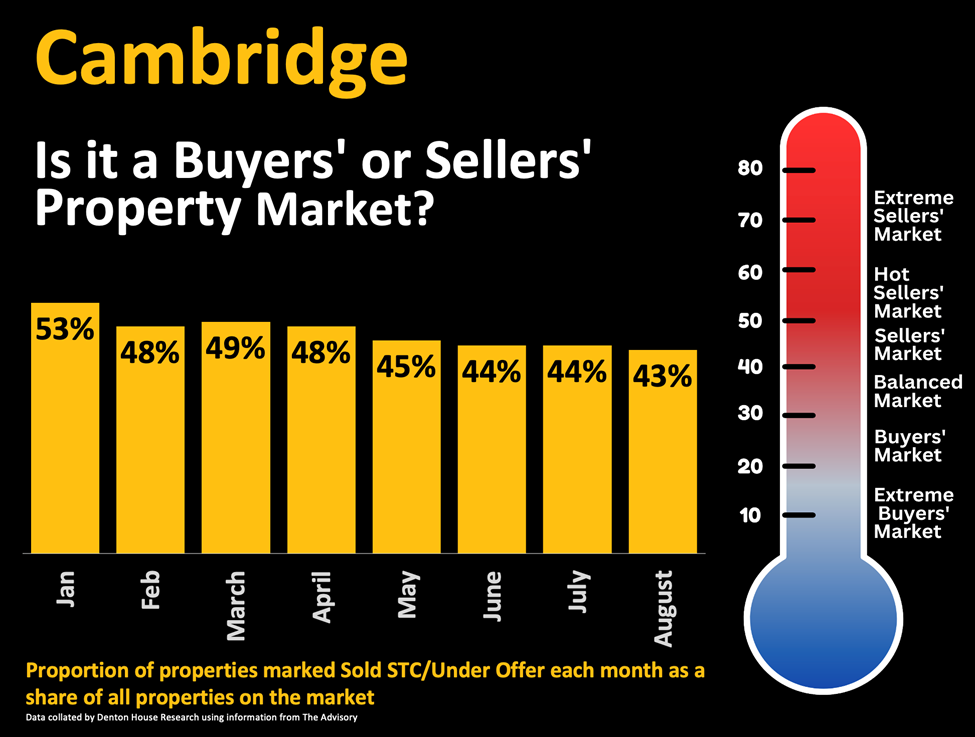
These percentage figures are an average of the Cambridge postcodes (as noted above).
For interest, if I break down the August 2025 figure by individual Cambridge postcodes, it actually tells an even more interesting story…
- CB1 – 49%
- CB2 – 46%
- CB3 – 35%
- CB4 – 50%
- CB5 – 36%
Look at the difference between the postcodes!
So, what does a 43% “Sold STC to total stock” ratio mean for Cambridge right now?
It places the local market at the lower end of a sellers’ market, giving sellers’ a slight advantage.
For Cambridge Sellers
We are firmly in a market where patience, presentation, and accurate pricing matter more than ever. Buyers now have a choice, a lot of choice. Simply listing your property and hoping for the best will not cut it.
The homes that sell are those that hit the market with the right price from day one, have high-quality photography, clear floor plans, engaging video content, and marketing that stretches both online and offline.
Overpricing is the fastest way to stall a sale. Properties that linger usually face price reductions, lose momentum, and invite lower offers. In some cases, that even leads to failed sales before the exchange.
Getting it right at launch is critical.
The good news is the recent interest rate cut provides a welcome tailwind as first-time buyers are seeing lower monthly payments, encouraging more of them into the market and strengthening chains. Also, home movers can access better fixed-rate deals, helping them upsize, remortgage, and release more homes onto the market to buy. Finally, buy-to-let investors in Cambridge’s stronger-yielding areas may see the sums stacking up again.
Buyer sentiment is shifting. Rate cuts show the Bank of England wants growth and stability, which converts hesitant “wait and see” buyers into active “let’s book a viewing” buyers.
This is not a one-off. The cut follows earlier reductions since late 2024. This means mortgage rates are more palatable, with some two-year fixes, at the time of writing, being below 3.75% on a 60% loan-to-value (LTV) basis, and an impressive 3.86% on a 5-year fixed (60% LTV). For first-time buyers with a 5% deposit, a 3-year fixed 4.78% rate on a 95% LTV mortgage looks pretty fair.
For Cambridge Buyers
The market is calmer than the frenzy of 2021 and 2022. There is time to think, compare, and in some cases negotiate. That does not mean you can wait indefinitely or fire in lowball offers. The best homes are still competitive, but opportunities exist if you are open-minded and look beyond the most sought-after postcodes. Have your mortgage agreement in principle ready before making an offer. It sets you apart and gives sellers confidence. Also, consider widening your search area, as value is often found just beyond the obvious hotspots.
Final Thoughts on the Cambridge Property Market
With inflation rising slightly (meaning interest rates won’t be coming down too much in the near future) and the Government finances looking a little squeaky, while the UK’s (and Cambridge’s) property market is enjoying a steadier footing, realistic pricing is the ultimate and most important thing in marketing a property. Remember last month, only 50.9% of homes that left estate agents’ books ended up being sold and the homeowner moving (the rest being withdrawn from the market unsold). Of course, you might not get what you would’ve got a few years ago in the crazy years of 2020 and 2021, but the price you’ll have to pay on the next one won’t be as much either.
If you are considering a move within the next six months or would like to explore your options, let’s talk. And even if you are not moving, I would love to hear your thoughts on where you see the Cambridge market heading.